US-CHINA TRADE WAR AND INDIA
US-China Trade War and India
The US-China trade war has taken the global economy by storm since 2018. Even before taking his place at the Oval Office, President Donald Trump had always been disgruntled at China’s trading policies, accusing them of devaluing their currency deliberately in order to boost their exports. He has on multiple occasions talked about slapping China with tariffs in compliance with his “America First” economic policy so as to reduce the American trade deficit. President Trump, true to his word, imposed 3 rounds of tariffs on China last July, sparking an all-out war. Now what is the picture going to look if we brought India into the equation? Things get more interesting as Trump has already revoked the preferential trade agreement the US had with India. What is the future in trade going to look like for these 3 countries?
US-China Trade War and its Effects on the US
Firstly, let us analyse the ongoing trade war between the US and China. As I had mentioned before, President Trump hit China with tariffs so that there would be an increase in the demand for domestic American goods and because the US government came to realize that their imports from China were far greater than what they exported to China. The US and China have been top trading partners since 2015 with China boasting nearly $500 billion in total exports and imports which is roughly about 15% of total U.S trade. In 2017, the total US merchandise trade with China was $636 billion which made China the US’ largest trading partner. Although this was the case, the US deficit was just increasing and it was one point that Donald Trump brought up in his election campaign.
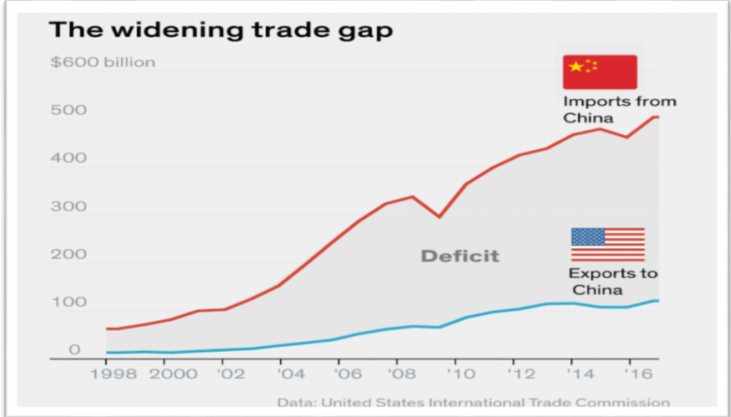
This graph is a clear depiction of the losses that the US government were running in 2017 and the whole trade war started in order to cut down this huge trade gap.
July 6, 2018 was the commencement of this trade war with the US slapping a 25% tariff on 818 imported Chinese products. The US then goes on to impose more tariffs with the Chinese then eventually retaliating with a 25% tariff on $34 billion worth of US goods. Now looking at the US China trade over the past years, we can see that they are huge trading partners with the US exporting goods worth $1.2 billion and importing good worth roughly around $5.4 billion from China in 2018. As a result, this huge trade war this trade war resulted in huge losses for both countries. Taking the USA, although President Trump has assured the country that the US is winning the trade war as China is paying his tariffs, further studies have shown that this trade war is costing US consumers and companies more than $3 billion a month. Statistically speaking, there is a huge increase in the trade deficit of the US when comparing 2017 to 2018. In the year 2017, the US trade deficit with China amounted to a total of $375,422 million while in 2018 (after the commencement of the trade war) the deficit shot up to $419,527 million. If we analyse closely we can see that there is a huge jump in the deficit figures (from $33,752 million to $36,986 million) from the month of June to the month of July as it was in July that President Trump started imposing his first round of tariffs on China. From then on, the deficit keeps increasing steadily and then it drops in the month of November which can be because of the truce talks held by both countries.
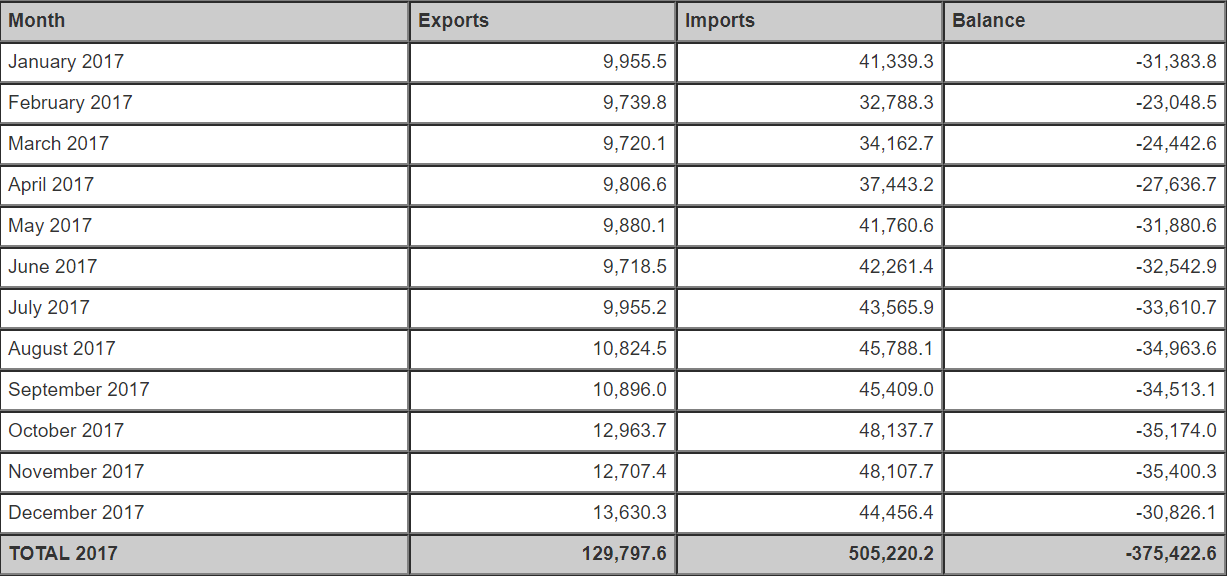
2017 US trade in goods with China
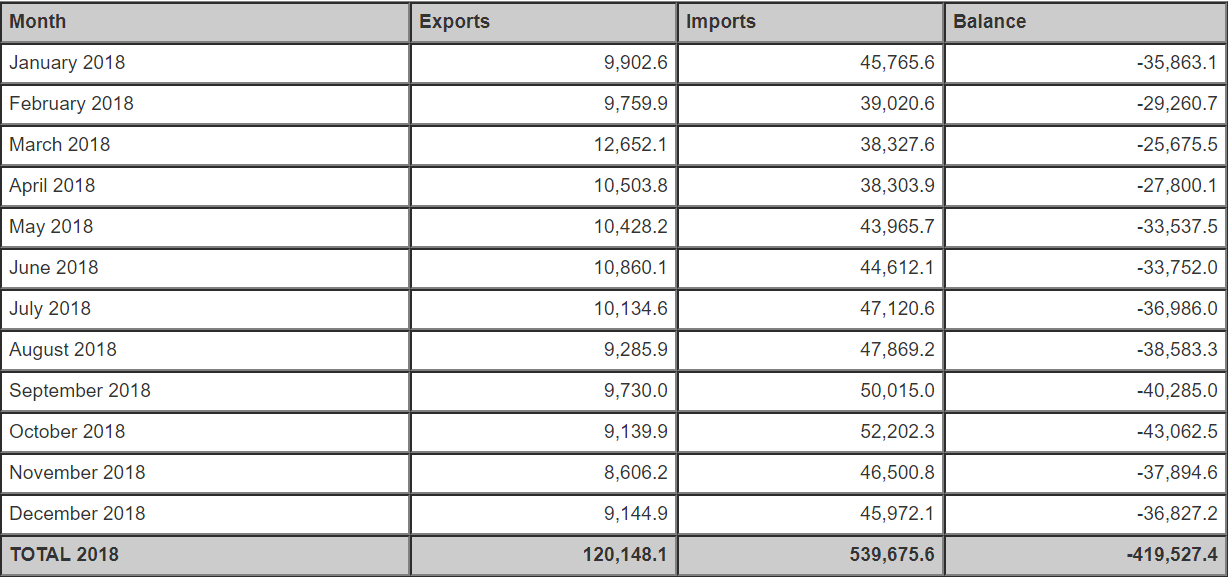
2018 US trade in goods with China
The two table above show the balance of trade if the US when trading with China in the year 2017 and 2018 respectively. From the data shown above, we can see that there is a clear effect on the balance of trade of the US with respective to China due to the trade war- a sharp rise in the US trade deficit. As I had mentioned above, although the purpose of the trade war was to decrease the trade deficit, the deficit just keeps increasing and there are 2 causes to this. First one being the fact that there is a huge rush of imports and the second being a huge crash in US exports to China. When talking about the imports, the issue is that the US appetite for Chinese goods has remained unabated since the start of the trade war which is partly due to the strong American dollar.
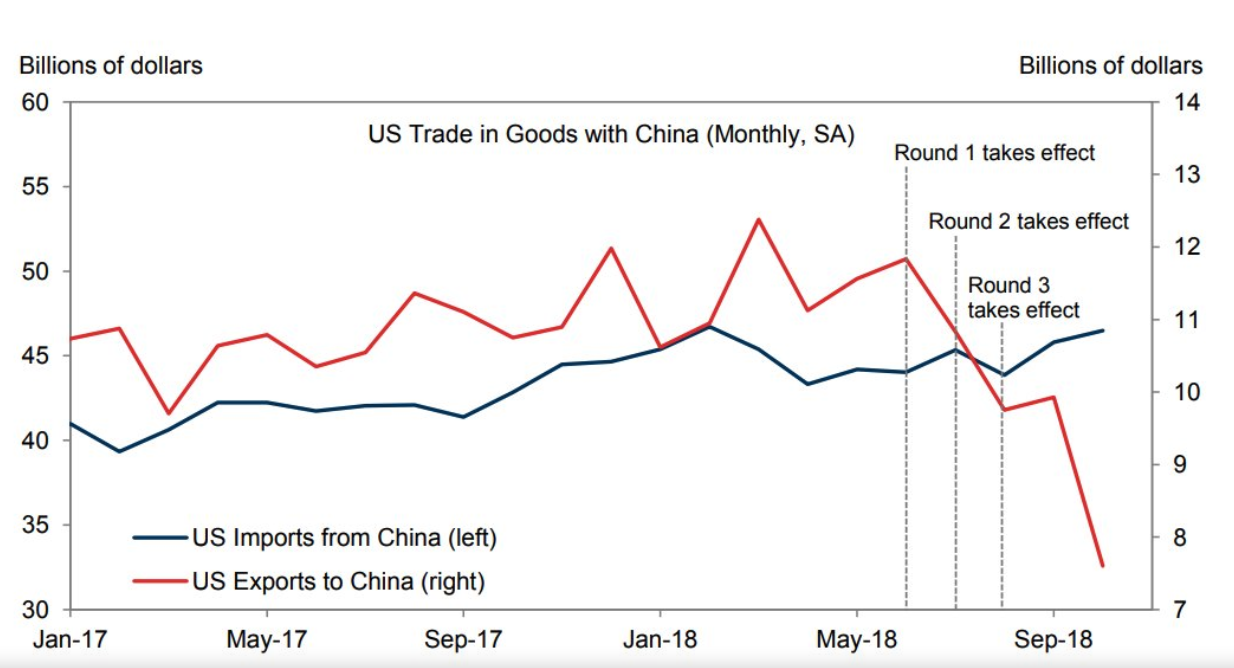
This graph shows that once the 2nd round of tariffs came into play, imports went up and exports sharply declined.
Inferences that can be drawn from the US-China trade war:
- US and China are strong trading partners.
- US deficit just increased after the trade war although the tariffs were placed in order to decrease the deficit.
- The US economy is dependent on Chinese goods.
India’s Role in this Trade War
In this part of the report I will be analysing the effect of the recent developments regarding the preferential trade agreement between India and the US. Preferential Trade Agreements (PTAs) give nations special access to each other’s markets resulting in a boost in overall trade. In the US it is known as the Generalized System of Preferences (GSP) and it is specially designed to promote economic growth in beneficiary countries. There are a few conditions that must be met by nations in order to be listed under the GSP programme:
- Provides the US with equitable and reasonable market access.
- Respecting Arbitral awards in favour of US citizens or corporations.
- Combating child labour.
- Provides adequate and effective intellectual property protection
- Respects internationally recognised worker rights.
In 2017, India was the largest beneficiary of the programme as $5.6 billion worth of exports were granted duty-free status all under GSP. According to US government statistics, India exported goods worth around $54 billion to the US and imported $33 billion worth of American goods. Currently, India is the 9th largest goods trading partner of the US with $87.5 billion in total two trade in the year 2018.
Since I am focusing on US imports with relation to India, these are a few statistics concerning that:
- India is the 10th largest supplier of good imports as of 2018.
- The top import categories in 2018 were: precious metal and stone, pharmaceuticals, machinery, mineral fuels, and vehicles.
- Total US imports of agricultural products from India totalled $2.7 billion making India the 15th largest supplier of agricultural goods.
The above are a few statistics regarding the US-India trade and is clear that much of the US economy relies on the raw materials imported from India and due to the preferential trade agreement, India is willing to supply the US with the required products as a lot of it is exempted from tax.
Effects on US-India Trade after India’s removal from GSP
On June 5, 2019, President Trump announced, “I have determined that India has not assured the US that it will provide equitable and reasonable access to its markets. Accordingly, it is appropriate to terminate India’s designation as a beneficiary developing country.”
Thus, India was removed from the GSP program and with that went all the benefits associated with the PTA. From the point of view of the US, importers will have to pay more to gain access to raw materials supplied by India and on the other hand American exporters will also face a hard time as they will now start facing trade barriers in India. India might also retaliate with tariffs which will further reduce trade between the two countries. The estimated losses for the US due to India’s removal from the GSP is approximately $300 million. Thus this decision taken by the Trump organization will certainly hamper the growth of American businesses as India is a massive market with plenty of opportunities and this GSP situation will result in Indian markets being harder to access. Experts are saying that withdrawal of the GSP benefit will adversely affect Indian exports.
Effects on the US
Now let us look at the possibilities of how the trade between the 3 countries are going to play out. So the current situation at hand is that the US has placed tariffs on China and in turn China has retaliated with their own set of tariffs so as a result, goods are super expensive for US importers to import from China. Now businesses that import their raw materials from China need to look for a cheaper alternative and they will start looking into other markets like India. Prior to the removal of India for GSP, this would have been possible as India would supply products at cheaper rates because their goods were exempted from taxes. Now that the GSP is taken away, Indian exports to the US will fall and there will be a shortage of raw materials (as mentioned above, India is one of the leading exporters of raw materials to the US) and thus, the US will have to rely on expensive imports from China and other countries. The US economy will most likely undergo cost-push inflation as local American producers will hike up their prices due to an increase in costs. Ironically, the trade war and the removal of India from the preferential trade agreement has just resulted in the US trade deficit worsening when the actual intention of President Donald Trump was the complete opposite.
Conclusion
In conclusion the trade war between the US and China has and will have multiple effects on the world economy. President Trump started this venture as a way of decreasing the deficit of the US and his decision to cut the preferential trade agreement with India has just worsened the trade balance of the US. This trade war has not been beneficial for any country and other means should be sought.
References
-United States Census Bureau, (2019). Foreign trade, Trade in Goods with India.
Retrieved from: https://www.census.gov/foreign-trade/balance/c5330.html
-Office of the United States Trade Representative, (2018). US-India Bilateral trade and Investment. Retrieved from: https://ustr.gov/countries-regions/south-central-asia/india
-Business Today, (2019). India-US: What is preferential trade status and how will its removal affect ties? Retrieved from: https://www.businesstoday.in/top-story/india-us-trade-spat-what-is-preferential-trade-status-how-will-it-affect-india-trade-with-us/story/324949.html
-CNN Business, (2019). India is a massive business opportunity for America.
Retrieved from: https://edition.cnn.com/2019/06/02/economy/india-us-trade-gsp/index.html
 US-China Trade War and India